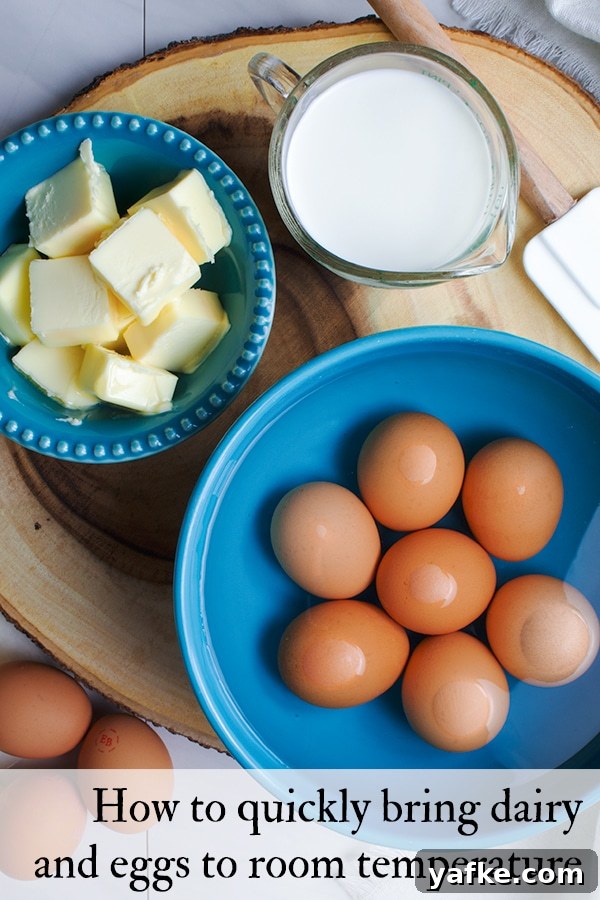

Many cake and cookie recipes tell you to use “room temperature” eggs and dairy. But is it really necessary that every ingredient reaches room temperature before you start baking?
Yes — it matters. Below is a clear explanation of why room temperature eggs and dairy affect your final bake, and practical, safe ways to bring them up to temperature quickly when you don’t have time to wait.

Why Bringing Dairy and Eggs to Room Temperature Matters for Baking
When eggs and dairy are at room temperature, they whip and blend more easily. Beating them with sugar or with an electric mixer creates a stable emulsion that traps air. During baking, that trapped air expands and helps give cakes, muffins, and some cookies their light, tender crumb. Cold ingredients are stiffer and harder to aerate, so batters made with chilled eggs or dairy tend to be denser and can bake up flat or tough.
Room temperature ingredients also combine more smoothly. For instance, cold butter doesn’t cream well with sugar — the sugar can sit in the butter rather than dissolving and incorporating, producing a grainy or uneven batter. When butter, eggs, and liquids are closer in temperature they emulsify and mix uniformly, which improves texture, crumb, and overall rise.
If a recipe asks for room temperature ingredients, follow that instruction. It truly influences texture and even baking, especially for recipes that rely on creaming or aeration for lift.
How to bring eggs to room temperature
The simplest method is to take eggs out of the refrigerator and let them sit on the counter for about two hours. Although some sources note eggs can be left unrefrigerated longer, two hours is a conservative and safe window to reach room temperature for baking.
If you need eggs sooner, warm water speeds the process. Place the eggs in a bowl and fill it with comfortably warm tap water — think bath-warm, not hot. Let them sit for roughly 10 minutes; this will bring the eggs up to room temperature without cooking them.
How to bring butter to room temperature

Butter can safely sit at room temperature longer than milk or eggs because of its higher fat and lower water content. Still, the easiest approach is to cut the amount you need into pieces and leave them on the counter for an hour or two until they are pliable.
If you’re short on time, soften butter quickly in the microwave. Place the pieces in a microwave-safe bowl and heat at 50% power for 20 seconds, then test with a knife or finger — you want the butter soft enough to spread easily, not melted. If it needs more, heat in 10-second intervals at 50% power until you reach the right consistency.
How to bring milk, cream, half-and-half, and buttermilk to room temperature

Milk, cream, and half-and-half should not be left out for long periods. To warm small amounts safely and quickly, pour the liquid into a microwave-safe measuring cup or dish and heat briefly. As a guideline, try 20 seconds for ½ cup, 30 seconds for 1 cup, and about 45 seconds for 2 cups, then stir and check the temperature. Microwaves heat unevenly, so stir and feel the liquid; continue in short 10-second bursts until it reaches room temperature.
Buttermilk requires extra care because heat can cause it to separate. Microwaving can create hot spots that start curdling, so a gentle warm-water bath is a better method. Pour buttermilk into a tall glass or jar, place that container in a bowl of warm (bath-temperature) water, and let it sit for 5–30 minutes depending on the volume. Stir occasionally to help the liquid warm evenly; a slight amount of separation is normal but avoid overheating.