Have you read anything by Laurie Colwin?
Laurie Colwin was an American writer based in New York City, known for both her fiction and the warm, witty essays she contributed to Gourmet magazine. Her writing about kitchen life felt personal and inviting, and it still resonates today. Those columns were collected as Home Cooking: A Writer in the Kitchen and More Home Cooking: A Writer Returns to the Kitchen, books that have become touchstones for lovers of thoughtful food writing alongside authors such as M.F.K. Fisher, Edna Lewis, and Alice B. Toklas.
Colwin died unexpectedly in 1992 at the age of 48, leaving behind a son, RF, who was eight at the time. RF Jurjevics is now an adult working as a writer, animator, and multimedia producer; he founded Big Creature Media some years ago. I contacted him last fall when Colwin’s books were released as ebooks for the first time, and he graciously agreed to take part in this interview.
I invited RF to join my Parents Who Cook series because I wanted to explore how children influence a cook’s life in the kitchen. This is the first installment in which the child speaks for themselves, and RF shared many touching and vivid memories about growing up with a mother who loved to cook. Below, he recalls childhood meals, family rituals, and the ways food shaped his childhood and his palate.
Please consider revisiting Laurie Colwin’s essays and books if you’re interested in home cooking, narrative food writing, or the pleasures of a life centered around the table.

Can you tell us a few words about the kind of child you were, and the kind of mother your mother was — both in general and with regards to food?

I was a headstrong kid who didn’t hesitate to speak my mind. A teacher once described me as the tallest in my class, and my mother jokingly called me her “Viking child,” a label that captured my imposing presence and blunt manner as a youngster.
My mother was similarly opinionated, and she liked that I had strong opinions of my own. Open dialogue was encouraged—though I could be a handful, pestering or arguing at times—but she welcomed my curiosity. She cared deeply about cooking, put great thought into what she made, and loved to have people gather around her table. She often asked guests to taste and comment; her joy was in sharing food, recipes, and conversation rather than keeping secrets about her methods.
That said, being the child who ate the “weird food” wasn’t always easy. She had firm ideas about what was good or bad—no plastic for perishables, jam made from scratch was preferable—and she rarely compromised. While many of my classmates eventually learned to love gingerbread, salmon, and asparagus at our house, I did envy the simpler treats they had: store cookies, American cheese slices, or brightly colored packaged juices. Some battles I won—fruit roll-ups of a particular kind—while others were lost. For years I was the kid with goat’s milk yogurt and smoked Gouda in my lunchbox, and later a friend admitted she was jealous: my lunches seemed exciting compared to her tuna and plain yogurt.
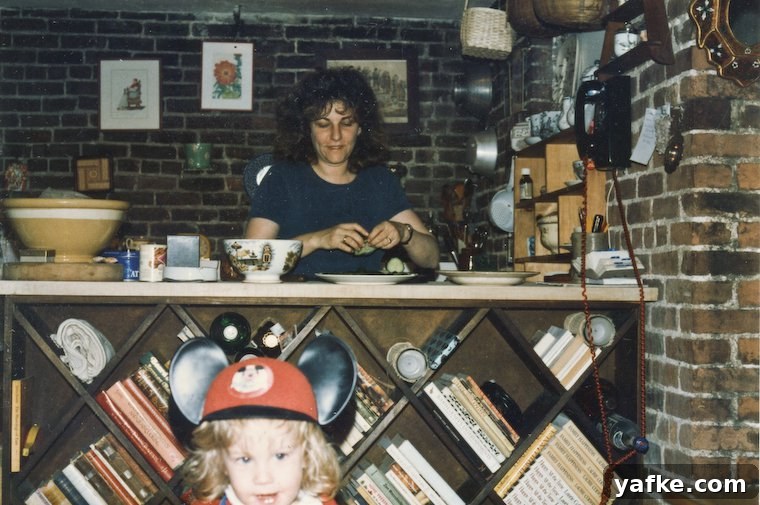
Laurie Colwin and then 2-year-old RF in 1986.

What did family meals look like when you were a young child (the good, the bad and the ugly)?

The meal I remember most vividly was our Friday night roast chicken—a ritual that functioned like a secular Shabbat. There were no prayers, but there were long candles, conversation about the week, and the slow-cooked, basted chicken itself. My mother would carve it at the table and the meat was always juicy and perfect.
She also loved dinner parties and treated them with care—filigreed silver for fish, a tureen for soup, and often an elaborate sheet used as a tablecloth. Parties ran late, and I’d be put to bed before they ended, listening from my room to the soft murmur of guests and their laughter. The only culinary misstep I recall was when she tried to make fish head soup; she realized it was a mistake and spared us the experience.

Do you think having a child changed the way your mother cooked, and if so, how?

Having me around, she got to fuss in new ways—fussing that included careful attention and small rituals, like cutting toast into postage-stamp pieces when I was sick. She watched me discover foods and relished those moments: my first taste of salmon, my enthusiasm for lemons and rhubarb, my rapid disappearance of cornichons from the plate. She loved the surprise of seeing me enjoy things she held dear.
She also made friends through cooking, inviting my classmates and their parents over and sharing food and traditions. One friend’s mother had grown up in Hong Kong, and those visits led to many trips to Chinatown for dim sum and wandering through pungent shops selling dried roots and herbs—scents that still take me back to those days.

Did your mother find ways to involve you in her cooking process, and if so, how? Do you think this came naturally to her, or did she make a conscious effort to include you in that part of her life?

I was in the kitchen with her constantly. Because she worked from home and picked me up from school, we spent a lot of time together there. Sometimes I watched, other times I worked alongside her: kneading bread, rolling dough, creaming butter and sugar, and mixing batters. If I got too fidgety she’d give me a small bowl and a little of what she was making so I could play and not be underfoot.
As I grew older I became more useful—making the salad dressing that had been her childhood task, setting the table, greasing pans, scraping batter from bowls, and folding napkins. I preferred the hands-on tasks to the other chores and enjoyed being part of the process.

What are some of your fondest food-related memories growing up around your mother?

There are many, but one stands out: the year we made a black cake for Christmas. It needed to age, so we baked it weeks ahead and stored it in a tin. I watched my mother make royal icing and we crafted marzipan decorations together. I remember the pride in seeing the finished cake on the table.
I also remember how she physically approached cooking. She favored oversized, heavy-knit sweaters and would push the sleeves up past her elbows when she worked. Though short in stature, she relied on strength and technique rather than electric gadgets—mixing in large bowls, chopping, and kneading by hand. We had a blender and a hand-crank eggbeater; my dad and I would use a handheld mixer for egg whites for his pancakes, but my mother preferred the more tactile methods.

What would you say are the most important lessons you learned from her about cooking and eating?

Beyond learning to make excellent gingerbread and preferring low-gadget techniques, the biggest lesson was how unifying food can be. A good meal brings people together across differences, soothes strain, and creates moments of connection. Dinner has a way of softening arguments, pausing feuds, and offering shared joy—simple but powerful effects that my mother understood instinctively.

If you’d like to have kids some day, how do you think you’ll go about teaching them to be happy, adventurous eaters?

If I have children someday, I’d follow my mother’s gentle philosophy: “You don’t have to like it, you just have to try it.” That approach gives kids agency—inviting them to taste without forcing them to eat something they dislike. It encourages curiosity and openness, and it worked for me: I discovered Brussels sprouts, poached eggs, Welsh rarebit, black bean soup, and fried zucchini blossoms because I was given the chance to try new things without pressure.